Night Walk in the Cloud Forest: What You Hear and What You See
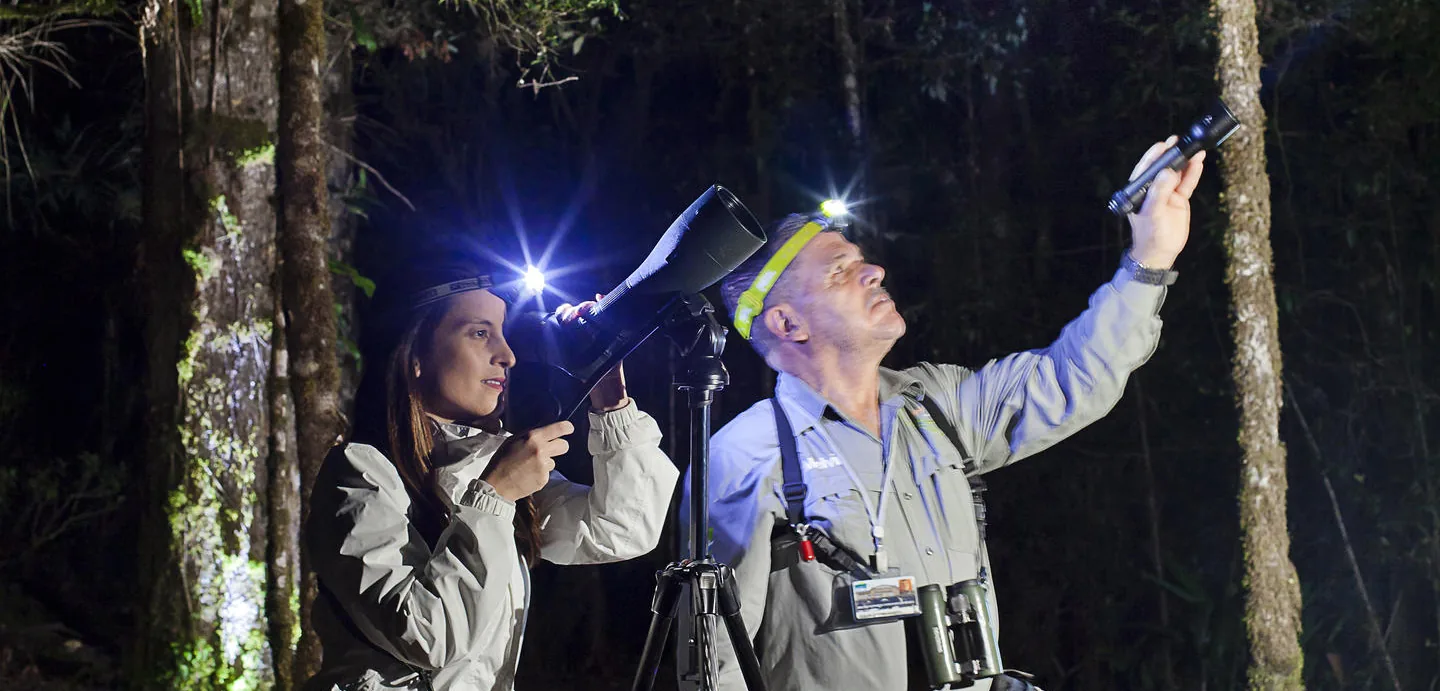
The cloud forest at night is a different place from the cloud forest in the morning: it becomes audible, and the species that appear are not the same. The guided night walk lasts around 3 hours, leaves from reception, and focuses on owls and nocturnal birds that are nearly impossible to find during the day.
- Duration
- Approximately 3 hours
- Departure
- From reception · 5:00 p.m.
- Guide
- Included
- Torch
- Not included · the guide carries the light
- Groups
- Small and large
- Minimum age
- None
- Price
- Per booking, 1 to 4 people · ask us
Tour details
Why the forest changes after dark
When the light goes, so does your visual reference, and hearing takes over. What is a continuous background by day separates into recognisable sources: insects, amphibians, water, and above all the calls of nocturnal birds — which is how a guide locates them before seeing them.
Many of these species spend the day motionless and camouflaged, and finding them in daylight is largely luck. At night, though, they call. And calling gives them away.
Species we look for
The nocturnal species we look for on the outing are the Dusky Nightjar, the Costa Rican Pygmy-Owl, the Bare-shanked Screech-Owl and the Mottled Owl. The Unspotted Saw-whet Owl is on the list too, though seeing one is exceptional. Nothing is guaranteed: these are wild birds and the night decides.
| English | Spanish | Scientific | Note |
|---|---|---|---|
| Costa Rican Pygmy-Owl | Mochuelo Costarricense | Glaucidium costaricanum | |
| Bare-shanked Screech-Owl | Lechucita Serranera | Megascops clarkii | |
| Mottled Owl | Búho Moteado | Strix virgata | |
| Dusky Nightjar | Chotacabras Sombrío | Antrostomus saturatus | |
| Unspotted Saw-whet Owl | Lechucita Parda | Aegolius ridgwayi | Very rare |
How the walk works
You book in advance and set out from reception with the guide. The pace is slow with long pauses: on a night outing, silence and listening yield more than distance covered. Torches are used sparingly — direct, prolonged light disturbs the animals and ruins the sighting for everyone else.
What to bring
Warm clothing, more than seems necessary: at night at 2,200 metres the temperature drops considerably and the slow pace does not generate heat. Closed shoes with good grip, a waterproof jacket, and a head torch if you have one — it keeps your hands free. A red filter is better, as it disturbs wildlife less.
Frequently asked questions
Is it suitable for children?
There is no minimum age, so yes. Bear in mind that the walk lasts about three hours after dark and that no equipment is provided: the guide carries the light, so bring your own torch for anyone who wants one.
Are owl sightings guaranteed?
No. These are wild animals and on many nights they are heard without being seen. Hearing them is part of the experience: the guide identifies each call.
Can I photograph?
It is difficult without specialised equipment because of the low light. And direct flash on nocturnal birds is harmful. Come to listen and watch rather than to photograph.
Interested in this experience?
Check availability