When and Where to See the Resplendent Quetzal in Costa Rica
The resplendent quetzal is best seen in San Gerardo de Dota between January and June, at dawn, near fruiting wild avocado trees. The Savegre river valley is one of the most reliable places in the world to see it in the wild, and our tour leaves at 5:15 a.m. precisely because that first hour of light is when the bird feeds.
- Duration
- 2 hrs 15 min
- Departure
- 5:15 a.m.
- Return
- 7:30 a.m. approx.
- Difficulty
- Easy — short walks
- Elevation
- 2,200 m (7,200 ft)
- Best season
- Year-round · best January to June, peak in March and April
- Guide
- Included
- Binoculars
- Not included · available to rent at the hotel
- Group
- Up to about 10 people
- Price
- Per booking, 1 to 4 people · ask us
- Booking
- In advance, at reception or with our team
Tour details
Why San Gerardo de Dota
The resplendent quetzal (Pharomachrus mocinno) lives in Central America's highland cloud forests, between 1,200 and 3,000 metres. San Gerardo de Dota sits at the heart of that range, at 2,200 metres, and it has kept what the bird cannot do without: mature forest with old standing trees, and enough wild avocados to sustain a stable population.
Our private reserve protects more than 500 hectares of that forest, within the same highland habitat corridor of the Talamanca range that Los Quetzales National Park belongs to, 25–30 km away by road. That continuity of mature forest is the underlying reason sightings here are routine rather than exceptional.
When to see it
January to June, peaking in March and April. This is the nesting season: quetzals defend territory, call more often, and move between fixed points, which makes them far more predictable. Outside those months they are still present, but they disperse and encounters become less frequent.
Time of day matters as much as the month. The quetzal feeds at first light, and after eight in the morning activity drops noticeably. Hence the 5:15 departure — not unnecessary rigour, simply the only hour when the forest works in your favour.
Wild avocados are the key
Guides do not look for the quetzal. They look for its food. Aguacatillos are trees of the Lauraceae family that bear a small fruit resembling a miniature avocado, and they are the backbone of the bird's diet.
The quetzal swallows the fruit whole and later regurgitates the seed intact, far from the parent tree. That makes it an essential seed disperser: much of this forest's regeneration passes literally through the inside of a quetzal. The relationship runs both ways — the forest feeds the bird, and the bird plants the forest.
This is why a guide who knows which trees are fruiting this week has an enormous advantage over someone simply walking and looking up.
How to recognise it
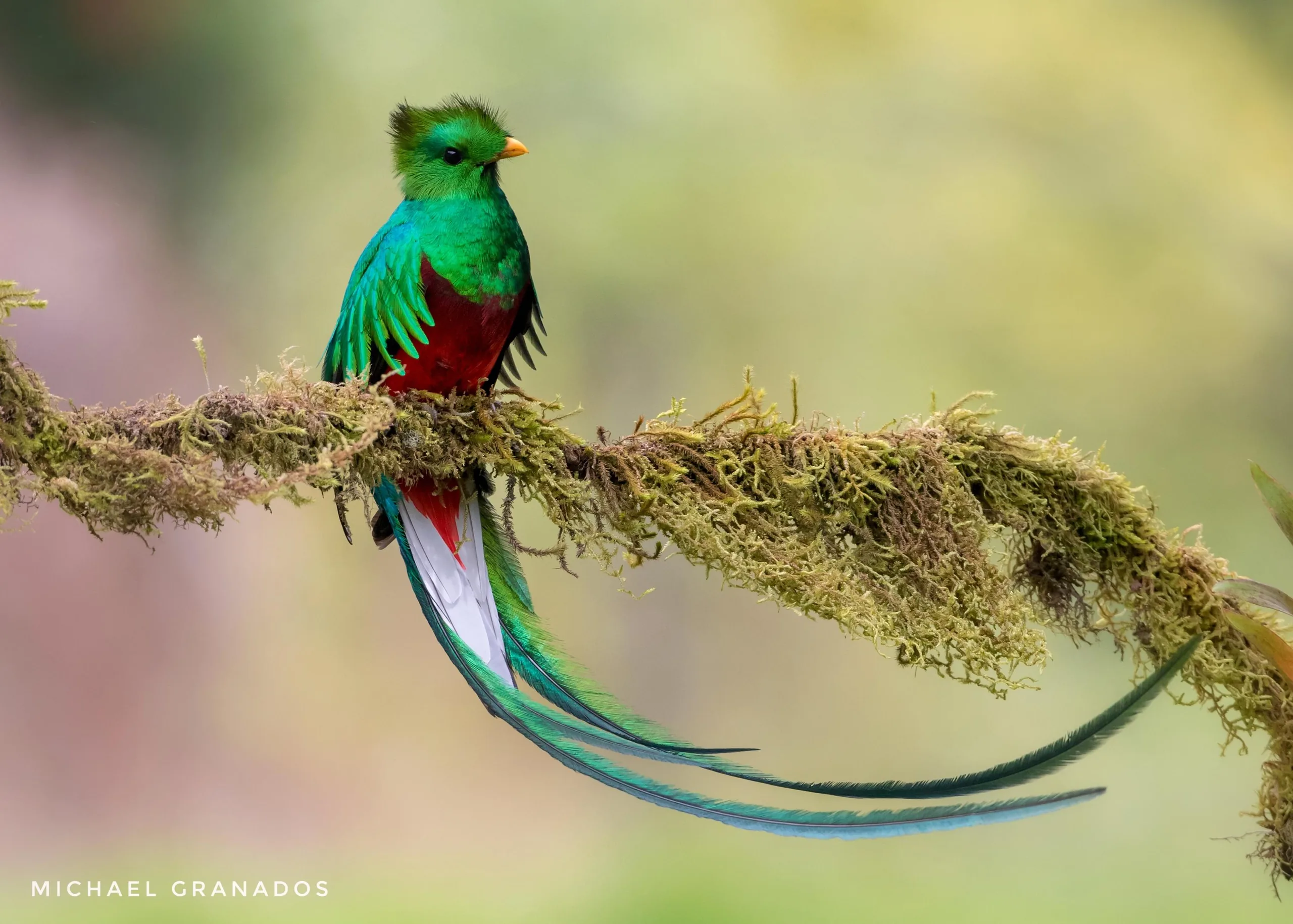
The male has iridescent green plumage that shifts with the light, a crimson breast, a rounded crest, and elongated plumes above the tail that can exceed 60 centimetres. They are not true tail feathers but greatly developed uppertail coverts — the detail that tends to surprise people seeing one up close for the first time. The female is more understated: muted green, greyish breast, and no long plumes.
You will usually hear it before you see it. The call is a soft, slightly mournful two-note whistle that carries well among the oaks.
A bird with a history
Mesoamerican cultures treated its feathers as goods of the highest value, reserved for Maya and Aztec elites; the name of the god Quetzalcóatl carries the bird within it. Today the quetzal is Guatemala's national bird and gives its name to the country's currency.
It is listed as Near Threatened by the International Union for Conservation of Nature, chiefly because of the loss of mature forest. That is why this valley matters beyond tourism.
What to bring
Warm layers — at five in the morning at 2,200 metres it is genuinely cold — closed shoes with good grip, a waterproof jacket, and binoculars if you have them. Bring a telephoto lens if you plan to photograph: the bird is usually high up and some distance away.
Frequently asked questions
Are quetzal sightings guaranteed?
No. It is a wild bird and no serious tour can guarantee it. That said, in high season and with a local guide, the odds here are among the best in the world. Staying two nights and going out on two mornings improves your chances considerably.
Is this suitable for someone with no birding experience?
Yes. No prior knowledge is needed and the guide does the work of finding and framing the bird. The walks are short and easy.
Can I go without a guide?
You can walk the reserve trails on your own, but your chances drop sharply. The guide knows which wild avocados are fruiting this week, and that single piece of knowledge is the difference between seeing a quetzal and walking for three hours.
Interested in this experience?
Check availability